

Climate factors that cause cold climate environments
The low temperatures
that characterise cold climate environments are the result of
four factors:latitude, altitude, continentality and
the temperature
of ocean currents.
Latitude
In high latitude
areas (i.e. 60-90oN/S of the equator) the angle sun
in the sky is low (Fig).
This means that incoming solar energy passes through
a greater thickness of atmosphere than in temperate (30-60oN/S)
or tropical (0-30oN/S) regions, and as a result a relatively
large proportion of solar energy is lost due to, absorption, back
scattering or reflection (Fig).
Furthermore, the low angle of incidence means that the
remaining solar energy is spread over a wide area, and much of this
incident energy is immediately reflected back into the atmosphere from
the surface
of snow and ice (Fig).
Therefore. polar areas, experience relatively
little surface heating and the climate is particularly cold
during mid-winter when these regions are in perpetual darkness.
Altitude
Temperatures
decline with altitude because air becomes thinner with height, and hence
is less able to trap heat. Furthermore, there is less land to absorb
and re-radiate heat from the sun. The decrease in temperature with altitude
is known as the environmental lapse rate and on average are 6.4oC
per 1000m. This dramatic fall in temperature explains why Mount Kilimanjaro
(5895 m) in central African is crowned with an ice cap while the surrounding
lowland plains are tropical grasslands.
Distribution of Land and Sea (Continentality)
The ability
of land and sea to absorb heat and radiate it back into the
air above
varies greatly. In general, land (soil and rock) warms up more quickly,
and is able to release the stored heat at a faster rate, than
water.
This contrasting nature has a dramatic effect on the pattern of seasonal
climate around the world. For example, continental interiors
are much
warmer than coastal areas during the summer because heating is more
intense and the land quickly releasing its stored energy. In
contrast,
continental interiors are much colder than coastal areas during winter
because the land has lost its stored heat, whereas, the sea
is still
radiating heat that it absorbed during the previous summer. The effect
of continentality is the reason why the South Pole (located
in the middle
of the Antarctic continent) is significantly colder than the North
Pole (located in the middle of the Arctic Ocean).
Ocean Currents
Oceanic currents,
in combination with the pattern of wind flow, exert a major a
control
the distribution of cold environments. For example, the climate of
the eastern seaboard of Canada is chilled by the cold Labrador
current, which flows southwards from the Arctic Sea.
In contrast,
Northwest Europe is warmed by heat released from the Gulf Stream,
and this explains why Arctic tundra in Canada extends southwards
to 54oN,
whereas in Britain, which is situated at the same latitude, tundra
is
absent and the winter climate is relatively mild(Map).
Climatic Characteristics of Cold Environments
Glacial Environments
The climate
of glacial environments is extremely variable and glacial
ice can form
under varing conditions of temperature and precipitation.
In martime areas, such as the Norwegian Alps, glaciers
can survive in relatively mild climatic regime
(i.e. mean annual temperatures may be no lower
than –2oC) because the
growth of glacial ice is sustained by abundant winter snowfall.
In contrast, in dry continental interiors,
such as central Antarctica, where annual snowfall is
usually less than than 200 mma-1,
glacial ice is able to form because the extremely cold climate
conditions (mean
annual temperatures average -30 to -40oC) limits
the amount of ice ablation.
The high latitude
of tundra regions ensures that the climate is very cold
and average
temperatures range between -5oC to -10oC.
During the long dark winter months temperatures regularly fall
below
-30oC and in central Siberia winter temperatures can
drop to -80oC. Daylight hours during the summer are
very long, indeed, during June and July the sun never sets. However,
as the angle of the sun is so low temperatures rarely rise above
10oC.
The climate of these areas is also very dry (mean annual precipitation
is usually below 150mm) since
they tend to occur within regions dominated by high pressure.
Hence
these areas are in fact polar deserts.
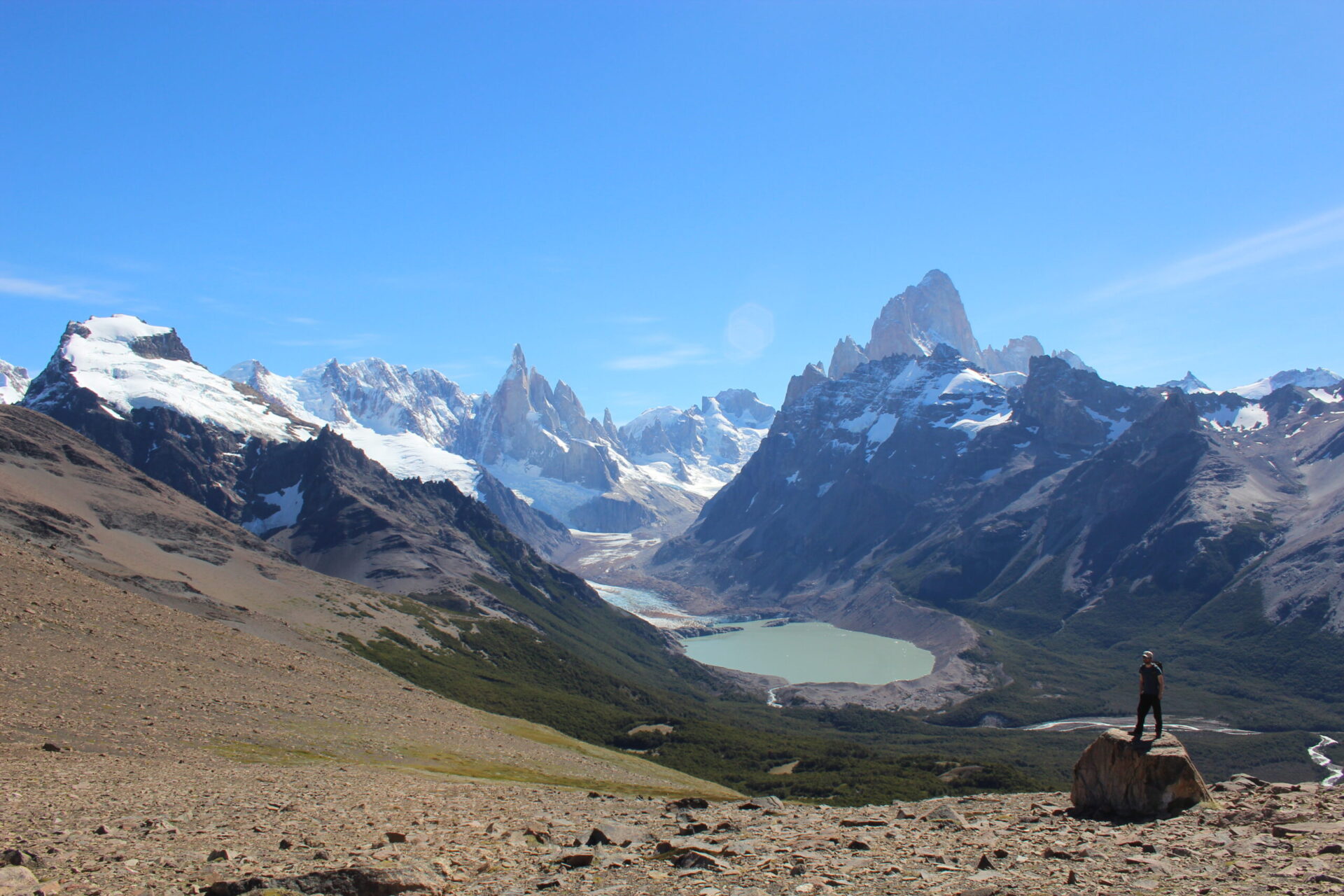
The climate
in high alpine areas is characterised by very low temperatures,
high precipitation and winds speeds that frequently exceed hurricane
force. Under such harsh climatic conditions trees can not
survive
and hence this distinctive cold climate regime lies above the treeline(Table
2) (the upper altitudinal limit of
trees). (Photo)Precipitation
is high as a result of forced uplift of air over mountains (relief
rainfall) and is particularly heavy in maritime regions. Since
much of the precipitation in mountainous regions falls as snow,
the summer thaw triggers dangerous hazards, such as floods, landslides
and debris flows. Mountain climates
in low and mid latitude areas (0-60oN/S) are also characterised
by a very high daily temperature range and frequent freeze-thaw
cycles.